
A child tries to fit a wooden cylinder into an opening. It does not fit. The child studies the pieces, selects a different cylinder, and tries again. No one has to announce, “Wrong answer.” The material itself gives useful feedback.
That small moment illustrates something important about Montessori education: children learn to think by doing. Rather than always being told what comes next, they have opportunities to observe, test ideas, and adjust their approach.
Critical thinking is not reserved for older students. Its earliest forms are visible when young children compare, sort, predict, question, and solve everyday problems.
Hands-on materials make thinking concrete
Before children can comfortably manipulate symbols on paper, they often benefit from physically exploring quantities, shapes, patterns, and relationships. Montessori materials make many abstract ideas visible and touchable.
For example, building a pattern with beads offers a different kind of understanding from simply memorizing a sequence. Sorting objects by texture or size invites comparison. Matching sounds helps children notice differences they might otherwise overlook.
When children can repeat the work, they also gain time to discover details missed on the first attempt.
The teacher guides instead of supplying every answer
A Montessori teacher carefully observes and introduces lessons, but does not need to narrate each step after a child has begun working independently. Sometimes the most useful response is a question: “What do you notice?” “How could you check?” or “Would you like to try again?”
The point is not to withhold help. It is to preserve opportunities for children to develop their own reasoning. If a task is too difficult, the adult can simplify it, model one step, or offer an appropriate new lesson.
Mistakes are part of discovery
Young children are often keenly aware of adult reactions. When every wrong answer is immediately corrected, they may begin focusing more on approval than understanding. Montessori encourages children to view an error as part of the learning process.
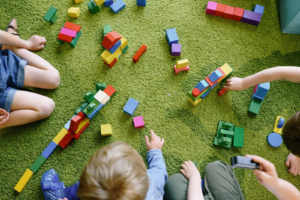
Imagine a preschooler building a tower that repeatedly falls. With time, the child might notice that larger blocks make a more stable base. That realization is powerful precisely because the child discovered it through experience.
Meaningful choices support decision-making
Choosing a lesson from a range of appropriate activities requires children to reflect on what they want to work on and what they already know how to do. Completing the work and putting materials away adds responsibility to that choice.
These are early executive-function experiences: planning, organizing, remembering steps, and managing attention. Children are not expected to master them instantly, but daily practice gives them room to grow.
Problem-solving includes working with other people
Not all challenges involve math or materials. Sometimes the problem is that two children want the same item or have different ideas about a shared project.
Teachers can model respectful language and help children consider possibilities: take turns, work together, or choose another activity while waiting. Over time, children begin generating solutions rather than relying on an adult to resolve every disagreement.
Encourage critical thinking at home
Try building with blocks, sorting laundry, making a simple recipe, or exploring how different objects float and sink. Invite your child to predict what may happen, then observe the result together. Use open-ended questions, but allow silence and thinking time.
You do not need a complicated experiment. A question as simple as “How can we carry all these books without dropping them?” can lead to practical problem-solving.
At Meadow Montessori School, these experiences are supported by our Montessori curriculum and our TEEAMS™ Approach, which incorporates Technology, Engineering, Environment, Art, Math, and Science. Our goal is not simply for children to know facts, but to grow comfortable exploring how things work.