Every parent has moments when they need an easy activity that does not involve another screen. The good news is that young children often need less entertainment than we think. A few thoughtfully chosen materials, and enough time to explore them, can inspire surprisingly rich play.
These ten activities are intentionally simple. Choose options that match your child’s current abilities and interests, supervise closely, and remember that repeating a favorite activity is perfectly worthwhile.
For babies: explore with the senses
1. A basket of safe textures. Offer a few large, clean, age-appropriate objects with different textures, such as a soft cloth, a smooth silicone teether, or a textured fabric square. Let your baby reach, grasp, and investigate. Avoid loose pieces, strings, and anything that could be a choking hazard.
2. Peekaboo with a light scarf. Use a breathable cloth in your hands to reveal your face or a familiar toy. Watch for your baby’s response and pause for anticipation. Never leave fabric over an infant’s face or within a sleep space.
3. Mirror and movement time. Place a baby-safe, shatter-resistant mirror at floor level during supervised awake time. Let your baby notice faces and movements. This pairs naturally with age-appropriate tummy time or floor play.
For infants, short, responsive interactions usually matter more than an elaborate setup. Follow your baby’s cues and stop when they seem tired or overstimulated.
For toddlers: move, transfer, repeat
4. Wash a toy. Put a little water in a shallow basin with a sponge and a few washable toys. Demonstrate squeezing the sponge and drying the toys afterward. Stay close: even shallow water requires constant adult supervision.
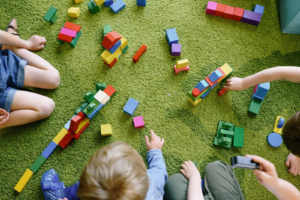
5. Build and knock down. Offer large blocks and let your toddler experiment with stacking, balancing, and rebuilding. You can describe “tall,” “short,” “more,” and “less” without directing the whole activity.
6. Match household objects. Gather several pairs of safe items, such as large matching socks or washcloths, and invite your child to find the pairs. Keep the number small at first and add more as interest grows.
Toddlers enjoy familiar routines, so an activity that seems repetitive to an adult may be exactly what a child wants to practice.
For preschoolers: create, investigate, imagine
7. Make a nature collection. On a walk, collect a few fallen leaves or interesting stones where permitted. At home, sort by size, color, or texture. Avoid sharp items and supervise children who may still put objects in their mouths.
8. Create an invitation to draw. Set out paper and a limited selection of crayons or washable markers. Rather than giving a model to copy, ask, “Tell me about what you’re making.” The process matters more than a polished result.
9. Build a simple obstacle course. Arrange cushions, floor markers, or a tunnel in a safe indoor space. Invite your child to plan a route, then change it. This combines gross motor play with sequencing and problem-solving.
10. Help prepare snack. Invite your preschooler to spread a soft topping with a child-safe utensil, wash fruit, or arrange food on a plate. Match the task to their skills and supervise food preparation carefully.
A few ways to make activities last longer
Offer fewer materials at once. A tray with four purposeful objects can be more inviting than a room full of scattered toys. Let your child repeat an activity, and avoid interrupting concentration simply to ask questions.
If your child loses interest, it may mean the task is too easy, too difficult, or simply not appealing that day. Put it away and try another time.
Screen-free play does not have to become a parent-led production. Sometimes the most valuable thing you can offer is an accessible environment and your calm attention.
At Meadow Montessori School, hands-on discovery is part of the daily learning experience from infancy onward. Explore our programs to learn how activities evolve with children’s developmental stages.