“I do it myself!” Few phrases capture the toddler and preschool years quite so perfectly. Sometimes those words arrive when everyone needs to get out the door in five minutes. Still, that impulse to try independently is worth protecting.
Children are not asking for complete freedom from adults. They are asking for the opportunity to test their abilities and take part in the world around them. When we provide appropriately sized tasks and patient guidance, independence becomes a source of genuine confidence.
Independence is a skill, not a personality trait
Some children are eager to try everything. Others watch carefully before participating or prefer an adult close by. Both can become increasingly independent through repeated, low-pressure opportunities.
A child who can pour water from a small pitcher may initially spill. A child who practices zipping a jacket may need help starting the zipper. Progress comes from experience, not from being told to be more independent.
The adult’s role is to notice what the child can reasonably attempt, demonstrate the steps, and offer support without taking over too quickly.
Make the environment work for your child
One of the simplest ways to encourage independence is to change the space rather than continually reminding the child what to do.
Try a low hook for a backpack, a small basket for shoes, a reachable place for pajamas, or a child-safe step stool where appropriate and supervised. Keep choices limited: two weather-appropriate outfits are often more manageable than an entire closet.
When the materials are accessible and the task has a predictable place in the routine, children can take responsibility without needing an adult to organize every step.
Offer real work, not just pretend work
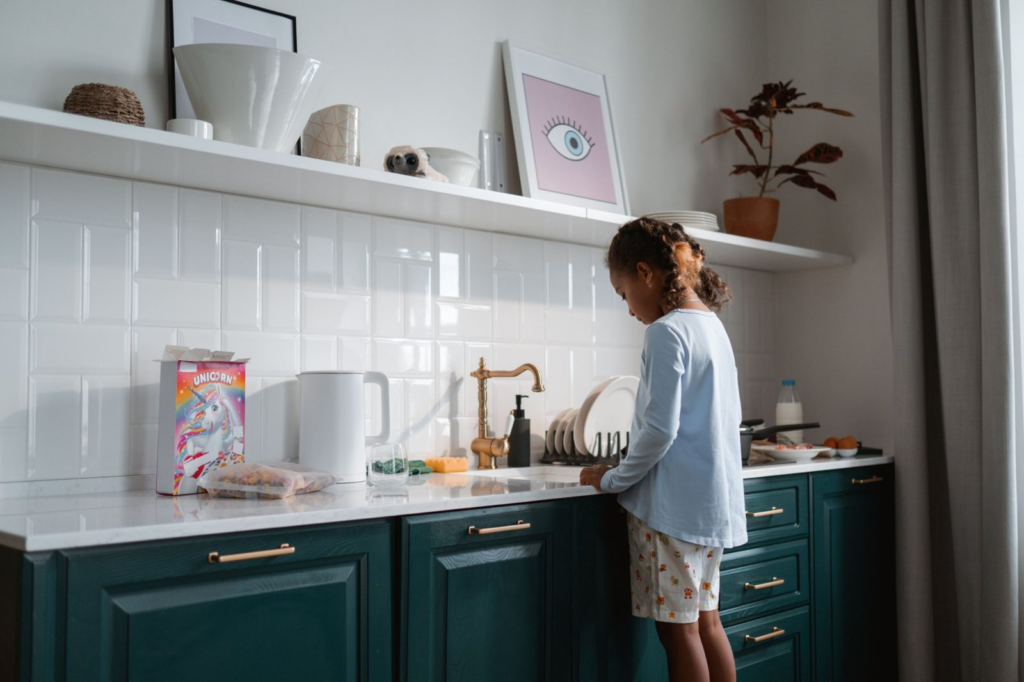
Many young children love participating in household tasks because they want to belong. Invite a toddler to carry napkins to the table, a preschooler to wash produce, or an older child to match socks after laundry.
Real work offers feedback that a pretend task may not. The table is set. The plant is watered. The basket is organized. Children can see that their contribution matters.
Choose tasks that are safe and manageable, with close supervision around water, tools, food preparation, and cleaning supplies.
Resist the urge to rescue immediately
Adults can often complete a task much faster. When a child struggles, our instinct is to fix it. Yet a little productive difficulty can help a child learn patience and problem-solving.
A useful approach is to pause, observe, and offer the smallest helpful prompt. “Would you like me to hold the sleeve while you put your arm through?” still leaves the child actively involved.
Of course, independence should not become a test of endurance. When a child is exhausted, overwhelmed, or genuinely stuck, helping is appropriate. The goal is confidence, not forced self-sufficiency.
Independence and connection go together
Children become more willing to explore when they feel secure. Predictable routines, warm relationships, and adults who respond to their needs create the emotional safety that makes risk-taking possible.
This is why Montessori independence looks different across ages. For an infant, it may mean freely reaching for an interesting object in a safe environment. For a toddler, it may mean washing hands with guidance. For a kindergartner, it may mean planning and completing a multi-step lesson.
Celebrate effort without making everything a performance
You do not need to applaud every small action. Sometimes a simple observation is more powerful: “You worked hard to get that shoe on,” or “You remembered where the cup goes.” Such comments help children recognize their own progress.
At Meadow Montessori School, independence develops naturally through daily routines, practical-life lessons, and patient guidance. Learn more about our infant, toddler, and Early Childhood programs to see how these opportunities grow with children.