Searching for a preschool can leave families with an unexpected question: What does “Montessori” actually mean, and how is it different from a more traditional preschool experience?
The answer is not that one type of school cares about children and another does not. Wonderful teachers and thoughtful learning environments exist in many settings. The difference is largely in how learning is organized, the role of the adult, and how much responsibility children are invited to take for their own work.
Here are some of the distinctions parents may notice when touring schools.
The classroom is arranged for children to use
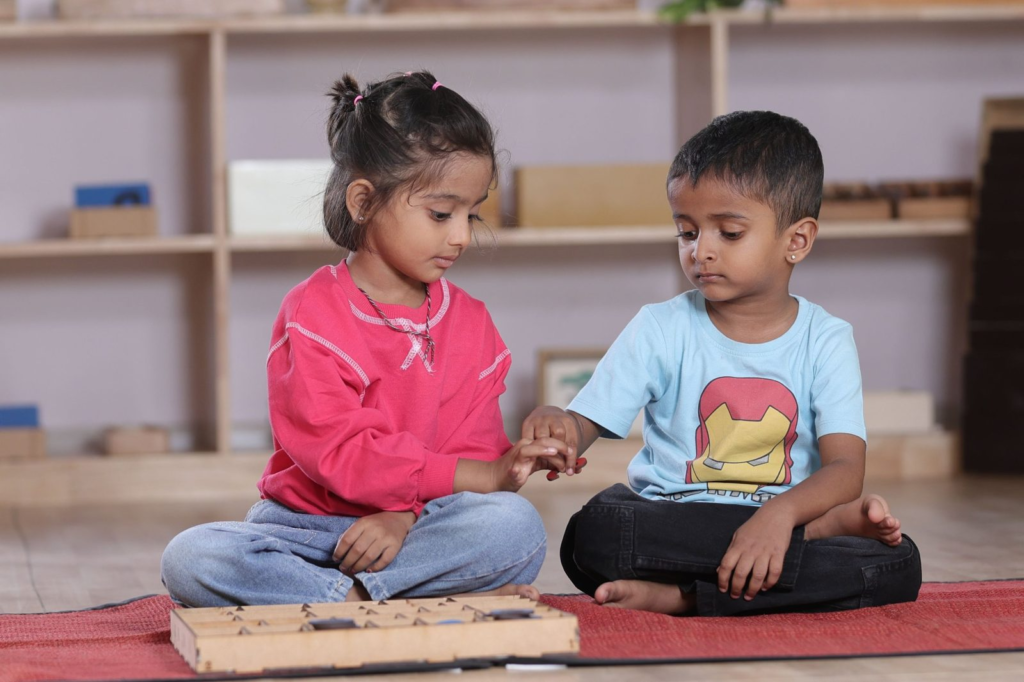
In a Montessori environment, you will typically find open shelves, carefully sequenced materials, child-sized furniture, and dedicated spaces for practical life, sensorial exploration, language, math, and cultural studies. Materials are not merely decorations or toys placed out for free play. They are intentionally chosen to help children develop particular skills.
A child can locate an activity, carry it to a workspace, use it, and return it for the next person. This physical organization supports order, decision-making, and independence.
Traditional preschools vary widely. Some use learning centers with similar features; others are organized around whole-group instruction, teacher-directed projects, or rotating activities. The important question is what children are actually doing during the school day.
Children have choice within clear boundaries
Montessori is sometimes described as “children doing whatever they want,” but that misses the structure. Children choose from lessons they have been introduced to, work within classroom expectations, and learn to respect other people’s space and materials.
Teachers observe each child, present new skills when the child is ready, and help maintain a purposeful work period. Children are not expected to figure everything out alone. Rather, they develop confidence by actively participating in the learning process.
In some traditional programs, teachers select the same project or activity for the class at a set time. Both approaches can offer valuable experiences, but the rhythm feels different to children.
Learning often moves from concrete to abstract
Think about learning the number ten. A worksheet can show the numeral and ask children to trace it. Montessori math materials allow children to see and handle quantities before moving toward written symbols and abstract operations.
Language learning follows a similarly intentional sequence, with oral vocabulary, sound awareness, hands-on letter work, and literacy experiences that build upon one another. The goal is not simply to get the right answer but to understand the underlying concept.
Mixed-age classrooms create a small community
Montessori Early Childhood classrooms commonly span ages three through six. Younger children observe older classmates completing increasingly complex work. Older children strengthen their understanding through helping, modeling, and explaining.
That does not mean every child receives the same lesson. Individual and small-group presentations allow teachers to respond to differing abilities, interests, and developmental stages.
Many traditional preschools group children more narrowly by age. Families may prefer different arrangements depending on their child’s needs, but mixed-age grouping is a defining Montessori feature worth observing firsthand.
What should you look for on a tour?
Rather than choosing a school by its label alone, watch the interactions. Are children engaged? Do teachers speak respectfully? Are materials organized and accessible? Is there a healthy balance between freedom and clear expectations? How do teachers respond when a child struggles or a disagreement occurs?
Ask whether lead teachers have Montessori training and how the school supports uninterrupted work time. You can also ask how progress is communicated and what a typical morning looks like.
Choosing the right fit
The best preschool decision is the one that gives you confidence in the people, environment, and approach supporting your child. At Meadow Montessori School, our teachers use thoughtfully prepared classrooms and individualized instruction to support children from infancy through kindergarten. Explore our programs or begin with a school tour to see the difference for yourself.